- EdTech Tidbits with Lisa
- Posts
- Sneaking Literacy into the Everyday
Sneaking Literacy into the Everyday
Using a Tier List & Flocabulary to Enhance Literacy Skills

Lisa Jones
March 04, 2024
Today, I'm excited to share with you a unique approach I recently took in my Exploring Careers course. I love calling these things sneaky literacy lessons. They are sneaky because most of the time the kids don’t even realize they are working on their reading and writing skills and this one was no exception. My students need extra support with their literacy skills and since part of my background is as a ELA teacher any time I can take a moment in my CTE classes to support their reading and writing I embrace it!

As the introduction to our entrepreneurship unit, I had the students identify the qualities and characteristics essential for entrepreneurs. Usually, I'm a big fan of Flocabulary for its engaging content, but sometimes the full lessons can be a bit overwhelming, focusing too much on vocabulary rather than the core content. So, I tailored a different approach this time.
Here’s how it went…
Setting the Stage
We kicked off by watching a brief one to one-and-a-half-minute Flocabulary video outlining the ten steps to becoming an entrepreneur. The vocabulary for this one didn’t really support my lesson but the overall message of the video did. After watching the video, I had the students revisit the lyrics, but this time with a very specific task in mind.
Highlighting the Essentials
As the students went through the lyrics again, I encouraged them to highlight only the ten steps of entrepreneurship. We did the first step together; I emphasized the importance of concise highlighting, steering away from highlighting full paragraphs. “Y’all highlight too much! You just need the most important parts, if you highlight more than 5 words in a chunk, you’ve done too much!” As we highlighted the first step together I talked through my process making sure I addressed the vocabulary. Specifically, discussions about unfamiliar words like "discern," which we decided we didn’t need to know, at least not yet.
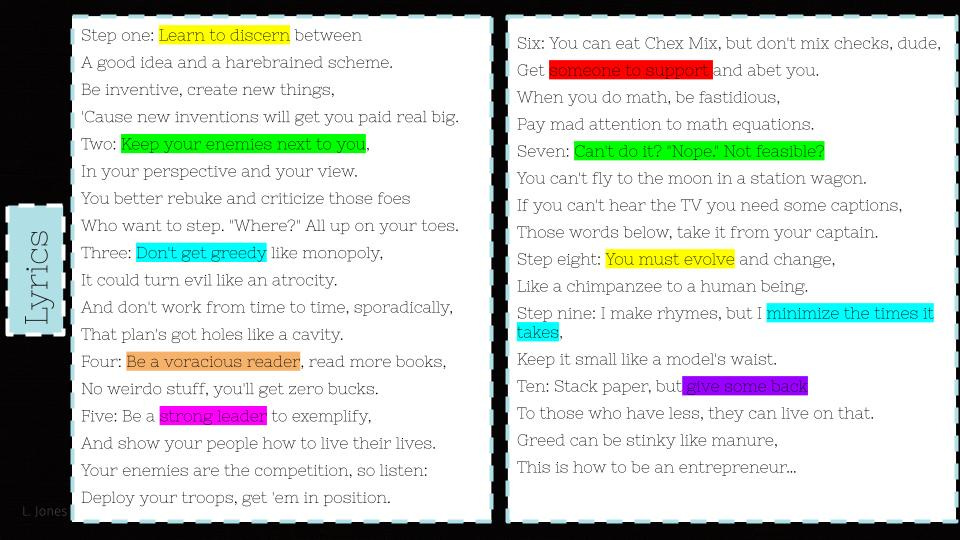
Highlighted Example
Reading and highlighting took a pretty large chunk of that class period. I circulated around the room as students worked alone, or in pairs to find the most important parts of each step. I checked their work, redirected conversations, and helped as needed.
Translating into Real-world Language
The following day, we focused on translating the highlighted text into seventh-grade language. This is when we tackled words like discern and voracious. I showed them how to use the built-in dictionary function in Google Slides to search for definitions as needed. They had to use context clues and the definitions they found to rewrite the steps into their own words. After I gave them time to “translate” we reviewed and came up with “translations” we could all agree on.
Using a Tier List for Analysis
This was probably the most popular part! Now it was time for analysis! Students engaged in a tier-ranking activity, assessing the importance of each step by placing them on a tier list ranking them from "S" (most important) to "F" (least important). This exercise encouraged critical thinking and prioritization skills. The students who were working in pairs debated with each other in order to come to agreement on where to place each step on their list. The only guideline I gave was that they couldn’t have more than two steps per tier.
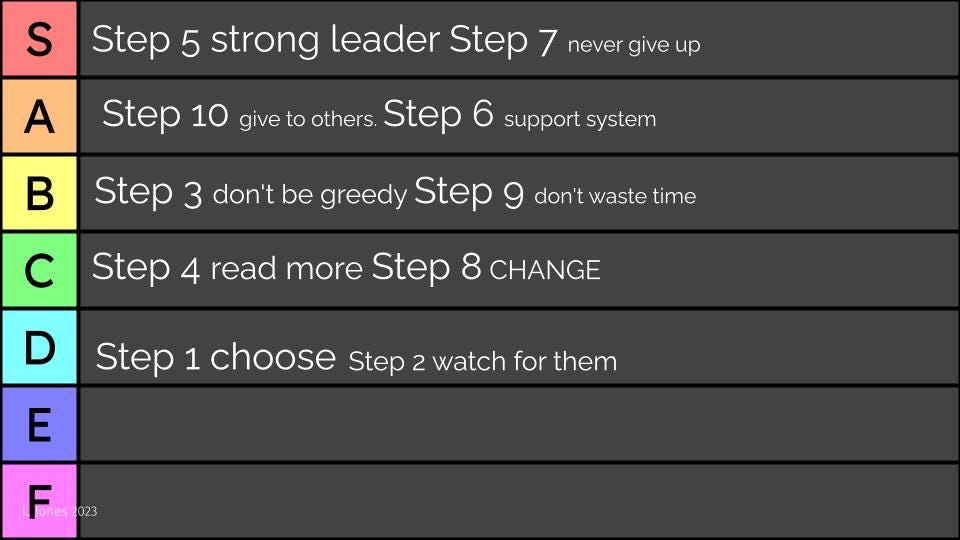
Student Example of Completed Tier List
Defending Decisions Through Discussion
Finally, students discussed their tier rankings with peers from different groups. I asked them to find someone in another group and defend their choices. This not only made them reflect on their own choices but also pushed them to communicate and defend their own thoughts.
Reflections on Sneaky Literacy
I love doing activities like this in my classes because so often students don’t realize they are exercising their reading skills. We hit multiple ELA standards 1 and I was shocked that I didn’t hear one complaint about having to read and write! Just like in real life, reading and writing should be everywhere in school.
Happy teaching!
1 Ohio’s Learning Standards:
RI.7.1 Cite several pieces of textual evidence to support analysis of what the text says explicitly as well as inferences drawn from the text.
RI.7.4 Determine the meaning of words and phrases as they are used in a text, including figurative, connotative, and technical meanings; analyze the impact of a specific word choice on meaning and tone.
W.7.9 Draw evidence from literary or informational texts to support analysis, reflection, and research.
SL.7.1 Engage effectively in a range of collaborative discussions (one-on-one, in groups, and teacher-led) with diverse partners on grade 7 topics, texts, and issues, building on others’ ideas and expressing their own clearly.
L.7.4 Determine or clarify the meaning of unknown and multiple-meaning words and phrases based on grade 7 reading and content, choosing flexibly from a range of strategies.